Rack 01Show lasers, explained
Laser Light Show Know-How: Las Vegas Shows and Professional Equipment
A Las Vegas laser light show looks effortless from the dance floor. Behind it sit diode modules, galvanometer scanners, a haze machine, a control laptop and a variance letter from the FDA. This site takes each of those apart.
Start with the equipmentHow a laser light show is put together
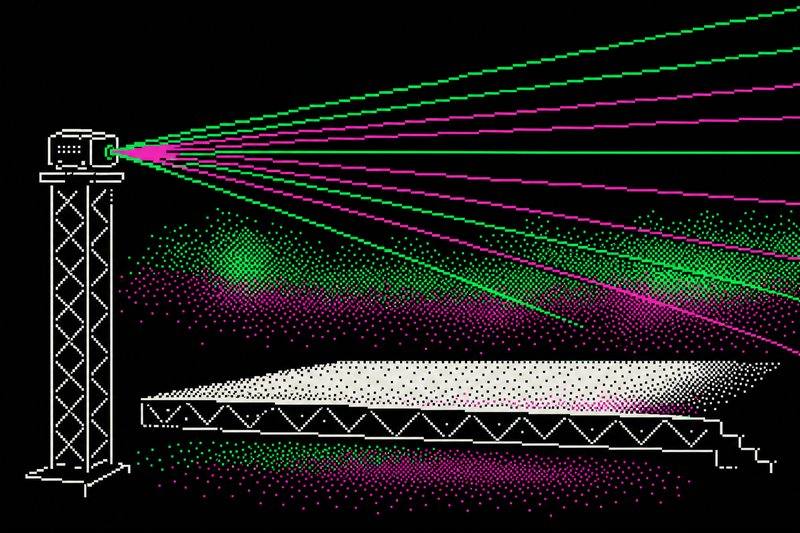
Every laser light show runs through the same chain, from a two-watt club unit to a stadium rig of thirty projectors. Light is made by laser modules, steered by two tiny mirrors, shaped by software and made visible by haze. Change one link and the look changes with it.
The light source in current projectors is almost always a set of semiconductor diodes: red around 638 nm, green around 520 nm and blue around 445 to 450 nm, combined by dichroic mirrors into one white-capable beam. Until the 2000s that job belonged to water-cooled gas lasers. Argon-ion and krypton tubes needed three-phase power and a plumber; copper vapor lasers, which glow at 510.6 and 578.2 nm, were the bright green-gold workhorses of the 1990s club circuit. A diode projector of the same brightness fits in a carry-on case.
The beam then hits a pair of galvanometer scanners, small mirrors on motors that swing thousands of times per second. One moves the beam horizontally, the other vertically. Scanner speed is quoted in kpps, thousands of points per second at the ILDA test angle, and it decides how much detail a projected logo can carry before it flickers.
| Part | What it does | Spec to read |
|---|---|---|
| Laser modules | Generate red, green and blue light | Output power in mW or W per color |
| Galvo scanners | Deflect the beam on two axes | Speed in kpps at the ILDA test angle |
| Control interface | Receives show data | ILDA DB-25, DMX512, Art-Net, Ethernet |
| Safety circuit | Stops emission on fault or key-off | Interlock, e-stop, scan-fail detection |
| Haze | Makes the beam visible in air | Particle size and hang time |
Haze is the part people forget. A beam in clean air is invisible except where it lands, which is why a laser light show in an empty, clear room looks like a handful of dots on the wall. The fog and haze guide covers the difference between a fogger and a hazer and why venues care.
Professional laser show equipment, part by part
Professional laser show equipment differs from party units less in brightness than in control: closed-loop scanners, a proper safety interlock, a published spec sheet and software that can be timed to music. The guides below follow that split.
Laser show equipment
Projectors, scanners, controllers and cases: what each spec on a data sheet means and which numbers are marketing.
Equipment guideLaser light show machines
Club lasers, stage projectors and outdoor units compared by power, scan speed and how they are controlled.
Machines comparedMoving head lasers
A laser projector on a motorised yoke can aim anywhere in the room. Rare, heavy and still impressive.
How moving heads workBeams, graphics and logos
The vocabulary of a show: beam effects, tunnels, liquid sky, projected text and the corporate logo reveal.
Laser show effectsLaser light shows and light shows in Las Vegas
Las Vegas has more lasers per square mile than almost anywhere, but most of them sit inside nightclubs and production shows where a ticket or a cover charge applies. The free spectacles on the Strip are mostly built from other light sources: the LED canopy over Fremont Street, the Bellagio fountains lit after dark, the Sphere's exterior screen and the xenon beam that points straight up from the top of the Luxor pyramid.
That distinction matters if you came looking for a Las Vegas laser light show in particular. Club rigs on the Strip run high-power RGB projectors over the dance floor, often with audience scanning restricted by the venue's FDA variance. Casino lounges and hotel ballrooms book laser acts for product launches and private events, the corporate side of the trade that rarely shows up in a visitor guide.
The Las Vegas light show guide lists what you can watch for free, where and at what times, and which shows are worth paying for.
What the FDA requires before a laser light show
In the United States, show lasers are electronic products regulated by the FDA's Center for Devices and Radiological Health under 21 CFR 1040.10 and 1040.11. Any projector above Class IIIa that is used for a public display needs a variance before it is switched on in front of an audience. The variance names the operator and the equipment and sets the conditions, such as beam heights and how close the audience may get.
| Class | Visible output | Typical use |
|---|---|---|
| II | under 1 mW | Barcode scanners, some pointers |
| IIIa | 1 to 5 mW | Pointers, small novelty lights |
| IIIb | 5 to 500 mW | Small club projectors |
| IV | above 500 mW | Professional show projectors |
Almost all professional laser show equipment is Class IV, so the variance is not paperwork you can skip. The laser safety guide explains the classes, the Form FDA 3147 application and what audience scanning means in practice.
Laser light show questions
How much does a laser light show cost?
It depends on projector count, programming time and travel. A single-projector set for a private party sits at the low end; a programmed show synchronised to a soundtrack with several Class IV projectors costs many times more, mostly because of the programming hours. The cost guide breaks the quote into its parts.
Is a laser light show safe for the audience?
It is when beams stay above head height or are scanned at measured levels below the maximum permissible exposure, and when the operator works under an FDA variance with a working emergency stop. The risk comes from static, unmeasured beams aimed into a crowd.
Do I need haze for a laser show?
For beam effects, yes. Without particles in the air you only see the spots where the beam hits a surface. Graphics projected onto a wall or screen work without haze.
What is the difference between a laser and an LED light show?
A laser produces a narrow, coherent beam that stays thin over long distances and can draw shapes. LED fixtures throw wide, soft light. Las Vegas uses both: LEDs for building facades and canopies, lasers for clubs and stages.
Where can I see a free light show in Las Vegas?
The Fremont Street canopy shows and the Bellagio fountains are free and run every evening. Schedules and the best viewing spots are in the Las Vegas guide.