Rack 07Rules before power-on
Laser Show Safety: FDA Variance, Laser Classes and FAA Rules in the US
Published
A five-milliwatt pointer and a twenty-watt show projector fall under the same federal regulation, yet only one of them can be sold at a gas station. The difference is the laser class, and in the United States the class decides whether a projector may be pointed at a stage, a dance floor or the sky at all.
The FDA, not OSHA, sets the rules for show lasers
Lasers are electronic products under federal law, and the agency in charge is the FDA's Center for Devices and Radiological Health, known as CDRH. Two sections of the Code of Federal Regulations do the work. 21 CFR 1040.10 is the general performance standard for laser products: classification, labels, key switches, emission indicators, interlocks. 21 CFR 1040.11 adds rules for specific-purpose products, and its paragraph (c) covers demonstration lasers, the category a light show projector belongs to.
That paragraph caps demonstration products at Class IIIa. Everything a professional rig uses sits above that line.
So the system works by exception. A producer who wants to run Class IIIb or Class IV equipment in front of the public asks the FDA for a variance from 21 CFR 1040.11(c), and the variance approval letter sets the conditions under which the show may run. States can add rules of their own; Florida and Illinois, for example, have their own laser regulations. The reference for all of it is the FDA's own laser light show page; what follows is a plain-language map, not legal advice.
Laser classes and where show projectors fall
US rules still use Roman numerals, while most data sheets print the international classes from IEC 60825-1. FDA Laser Notice 56 lets manufacturers use parts of the 2014 edition of that standard instead of matching sections of 21 CFR 1040.10. For visible continuous-wave light the boundaries line up closely:
| US class | IEC class | Visible output | Show use |
|---|---|---|---|
| I | 1 | Not hazardous in normal use | Enclosed systems, some effects at low power |
| II | 2 | under 1 mW | Toy and novelty projectors |
| IIIa | 3R | 1 to 5 mW | Pointers, home party lights |
| IIIb | 3B | 5 to 500 mW | Small club projectors, variance required |
| IV | 4 | above 500 mW | Professional stage and outdoor projectors, variance required |
The class describes the worst case at the aperture, not what the audience receives once the beam is scanned and spread. That gap is where most of the safety engineering happens. The machines comparison lists which power bands are common in clubs, theatres and outdoor work.
ToolClass check
Estimate the class of a visible show laser
Enter a projector's continuous-wave output power and its wavelength to see which US laser class it falls into and whether a public show with it needs an FDA variance. It uses the visible continuous-wave limits from the table above.
Form FDA 3147, Form FDA 3640 and the variance letter
Three forms come up again and again. Form FDA 3147 is the variance application itself. Form FDA 3640 is the laser light show report, which describes the show: projectors, beam paths, effects, distances to the audience and the controls that keep exposure in bounds. Form FDA 3632 is the product report for the projector, filed by or for its manufacturer. If you buy a projector whose product report is already on file, the FDA page says you need only the show report and the variance application.
Everything goes to CDRH by email. Work can start only once the approval letter has arrived. FDA guidance says variances are generally granted for two years, a variance cannot be transferred from one firm to another. Variance holders also file an annual report, Form FDA 3636, which the FDA cover sheet ties to keeping the approval running.
A nightclub or convention hall booking a laser act can ask for a copy of the variance letter before load-in, and a hire company that cannot produce one is a company you should not hire.
Audience scanning and maximum permissible exposure
Maximum permissible exposure, or MPE, is the highest level of laser light the eye or skin can receive without expected injury. The values come from the ANSI Z136.1 standard and depend on wavelength and exposure time: a beam flicking past an eye is treated differently from one that sits still.
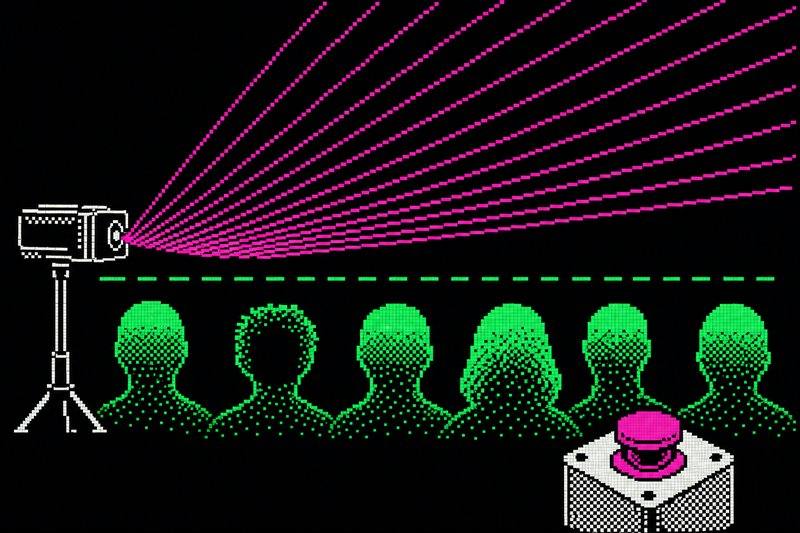
The default under a variance keeps light above the Class I or Class II level away from the crowd altogether. Older FDA guidance and several state rules use the same geometry: no hazardous beam less than 3 meters above any surface the audience can stand on, or less than 2.5 meters to the side of any audience position, unless barriers keep people out. That is why club beams fan out over heads rather than through them.
Audience scanning, where beams deliberately pass through the crowd, is a separate case that the variance must specifically allow. It rests on measurement: the operator shows, at the closest audience position, that the scanned beam stays below the MPE, and that a scan failure cuts emission before a stalled beam can do harm. Liquid sky and tunnel effects sit right on this line, as the effects guide explains.
Outdoor beams and FAA Form 7140-1
Once a beam leaves the building, a second agency gets a say. The Federal Aviation Administration asks operators to file Form FAA 7140-1, the Notice of Proposed Outdoor Laser Operation(s), at least 30 days before the event, with a laser configuration worksheet for each setup and diagrams of the planned beam paths. The FAA service center for the area runs an aeronautical study and answers with a letter of determination: no objection, or an objection that stops the laser use until the issue is resolved.
The thresholds come from FAA Advisory Circular AC 70-1B, which defines flight zones around airports where visible light must stay below set irradiance levels, down to 50 nW/cm² in the laser-free zone closest to runways, to avoid glare and flash blindness in a cockpit. Anything outdoors on the Strip sits a few miles from the runways of Harry Reid International, so the study for a Las Vegas outdoor show is rarely a formality; the free spectacles in the Las Vegas guide mostly use LEDs, water and searchlights instead. The circular also covers safety observers, people posted with a direct line to the operator who cut the beams if an aircraft approaches.
Emergency stop, interlocks and scan-fail protection
21 CFR 1040.10 requires a key control and an emission indicator on Class IIIb and IV products, plus a remote interlock connector on Class IIIb and IV units. In a show rig that connector is where the emergency stop goes: a latching button within reach of the operator, wired so that pressing it kills emission on every projector at once, not just the one in front of the desk.
Scan-fail detection watches the galvanometers. If the mirrors stop moving, the beam would collapse from a harmless fan into a single concentrated point, so the circuit shuts the light off within milliseconds. Ask a supplier how it is tested, not whether it exists. The equipment guide explains where each of these parts sits in a projector.
Eye safety basics
Visible laser light is dangerous to the eye because the lens focuses it to a tiny spot on the retina, multiplying the irradiance many thousands of times. The blink reflex takes roughly a quarter of a second, enough to protect against a brief Class II exposure and nowhere near enough for Class IV, where damage can happen faster than the eye can close.
Class IV beams are also hazardous by diffuse reflection off a matte surface at close range, and they can burn skin and ignite dark fabric. Crew aligning projectors wear eyewear rated with an optical density for each wavelength in the projector, which for an RGB unit means glasses covering red, green and blue at once; ordinary sunglasses do nothing useful.
Laser show safety questions
Do I need an FDA variance to run a laser show?
For Class IIIb or Class IV projectors used in a show for the public, yes. Usually the show producer or the company supplying equipment and operator holds it.
What is the difference between Form FDA 3147 and Form FDA 3640?
Form FDA 3147 is the application asking for the variance. Form FDA 3640 is the laser light show report that describes the show and its safety measures.
Is audience scanning legal in the United States?
Only when the operator's variance specifically allows it and the exposure at the audience has been measured below the maximum permissible exposure. Without that permission, beams above the Class I or II level stay above and beside the crowd.
Does an outdoor laser show need FAA approval?
Outdoor beams that could reach navigable airspace are notified on Form FAA 7140-1 at least 30 days ahead. The FAA replies with a letter of determination, and an objection means the show does not use lasers until the issue is settled.
Can haze make a laser show more dangerous?
Haze does not change the beam's power, but it makes beams visible, which is the point. It can also hide a misaligned beam from a casual glance, so operators check alignment with the room clear. The fog and haze guide covers the venue side.