Rack 02Gear, part by part
Professional Laser Show Equipment: A Guide to Projectors, New and Used
Published
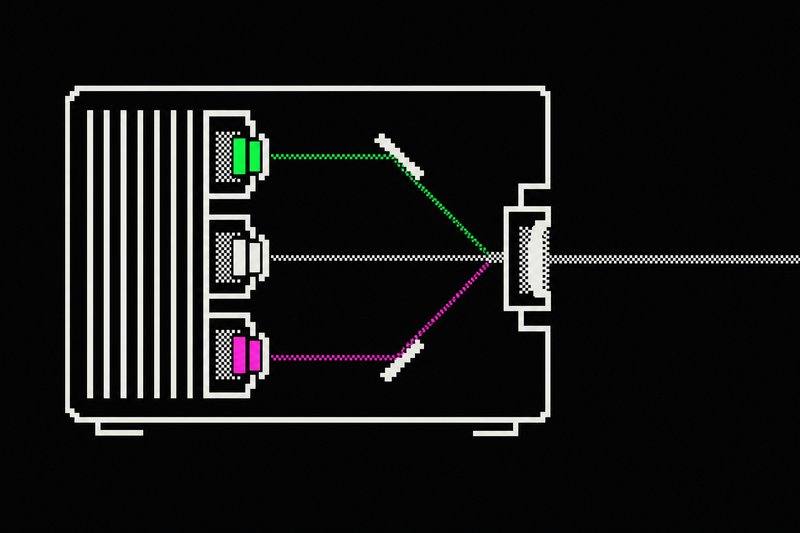
A projector is only the most visible piece of laser light show equipment. The rest is less photogenic: a controller and the software behind it, cables that carry show data and safety signals, a haze machine, flight cases, and the paperwork that lets a Class IV beam run in front of people at all.
Buyers usually start with output power, because it is the biggest number on the box. It is also the number that tells you least about how a show will look. Two projectors rated at the same wattage can differ completely in beam quality, scanner speed and how gracefully they fail, and those three decide whether a unit belongs on a touring rig or in a spare room.
What professional laser show equipment consists of
At the core of professional laser show equipment sits the projector: laser modules, the optics that combine them, two galvanometer scanners and a safety circuit, all inside a housing with an aperture at the front. Current projectors use semiconductor diodes in red (around 638 nm), green (around 520 nm) and blue (around 445 to 450 nm). Dichroic mirrors stack the three colors into one beam so the projector can mix white and anything in between.
Around the projector sits the control layer. Most show projectors accept the analogue ILDA signal over a DB-25 connector, and many also take DMX512 or a network protocol such as Art-Net. Software such as Pangolin's Beyond or QuickShow writes the frames, a network interface carries them to the projector, and an emergency stop within reach of the operator can kill emission instantly. A show that is supposed to sit with the rest of the lighting rig also needs a route into the lighting desk, which usually means DMX.
Then come the things that make the light visible and the rig portable: hazers, truss clamps, safety cables, and road cases with foam cut for each unit. The fog and haze guide explains why a beam in clean air is close to invisible.
ToolColor mix
Mixing red, green and blue diode beams
Set the output of the red, green and blue modules to see how the combined beam changes color. Perceived color depends on the relative power of each module and on how sensitive the eye is to each wavelength.
Reading a spec sheet: a short guide to the numbers
Spec sheets for show lasers follow a loose convention, and the gaps between the lines matter as much as the numbers. The table below lists the entries worth reading and what each one hides.
| Entry | What it means | What to ask |
|---|---|---|
| Output power | Total optical power, usually summed across colors | Power per color, and whether it is measured or nominal |
| Scan speed (kpps) | Points per second the scanners can draw at the ILDA test angle | Which test angle, usually 8 degrees, and whether the ILDA test pattern runs clean |
| Beam diameter and divergence | Size of the beam at the aperture and how fast it spreads, in mm and mrad | Whether all three colors match, or one color blooms |
| Modulation | Analogue or TTL control of each color | Analogue is needed for smooth fades and color mixing |
| Inputs | ILDA DB-25, DMX512, Art-Net, network interface | Which software the network input works with |
| Safety features | Key switch, remote interlock, emission delay, scan-fail | Whether scan-fail detection is built in or an option |
Two entries deserve a closer look. Output power is often the sum of nominal diode ratings, while the light that leaves the aperture after the combining optics is lower, sometimes by a lot. Scan speed is quoted in kilopoints per second at the ILDA test angle, and the honest version of the claim is that the scanners can draw the ILDA test pattern at that rate without distorting it. A projector whose blue diode is twice as wide as its green one will draw fat, uneven beams no matter what the wattage says.
Divergence is the quiet number. Low divergence keeps a beam tight across a large room, which is what you want for a long beam effect over a festival field, and it also changes the safety calculation because the energy stays concentrated further out.
Static projectors, moving head units and effect lasers
Most professional rigs are built from static projectors, boxes that bolt to a truss and scan within a fixed window, typically up to about 60 degrees. Point them somewhere else and someone has to climb the truss. A moving head laser solves that by putting a projector on a motorised yoke, so the whole scan window can be aimed around the room from the desk. The moving head guide covers how those units work and why they are uncommon at high power.
Below both sit effect lasers: units with gratings or a single motor that throw a fixed pattern of dots or lines. They are cheap, they need no programming, and they belong to a different category of buyer. The comparison of laser light show machines sorts club units, stage projectors, outdoor projectors and party lasers by what each one is for.
For a mixed rig, a common pattern is several static projectors carrying the show, with a moving head laser or two added for looks that need to travel.
Buying used laser show equipment: what to check
Used laser show equipment can be a sensible buy, because projectors from established makers are built to be serviced and a good unit can outlive several owners. It can also be a box of tired diodes, and laser show equipment rarely says which from the outside. The checks below are the ones that separate the two, and most of them can be done in an afternoon with the seller present.
- Diode hours. Laser diodes lose output with use and heat. Some projectors log operating hours; where they do, ask for the figure, and in any case measure the output of each color with a power meter rather than trusting the label.
- Scanner condition. Run the ILDA test pattern at the rated speed. Overshoot, ringing or a pattern that drifts as the unit warms up points to tired scanners or drivers that were tuned for a different set.
- Interlocks and controls. Key switch, remote interlock connector, emission indicator, emission delay and the shutter or beam stop all have to work. Pull the interlock plug mid-show and the beam should stop at once.
- Alignment. Project a white beam onto a far wall. Three colored dots instead of one white one mean the dichroic mirrors have shifted.
- Labels and FDA records. A projector sold for shows in the US should carry the manufacturer's certification and identification labels, and the maker should have a product report on file with the FDA.
The last point trips up more buyers than the hardware does. An FDA variance for laser light shows is granted to a person or company, not to a box, so it does not move with the projector when the projector is sold. The new owner needs a variance of their own, or an amendment to an existing one that adds the unit, before it goes in front of an audience; ask the seller for the model's documentation and the identification details you will need for that filing. The laser safety guide walks through Form FDA 3147 and what a variance covers.
Buying new removes most of that uncertainty and adds a warranty.
Argon, krypton and copper vapor next to RGB diodes
Older laser light show equipment looks nothing like a current projector. Argon-ion lasers, with their strong lines at 488 and 514.5 nm, gave the blue-green beams of the 1970s and 1980s planetarium and concert shows; krypton tubes added a red line at 647.1 nm, and mixed-gas tubes combined both to get something close to white. Copper vapor lasers, emitting at 510.6 and 578.2 nm, were bright green and gold, pulsed, and hot.
All of them were large, inefficient and thirsty. A big argon or mixed-gas system needed three-phase power and a water supply to carry the heat away, and a tube replacement was a serious line in the budget. Much of the surviving gear now trades among collectors and enthusiasts rather than working shows, and it needs someone who knows how to handle the high voltages inside. A small diode projector delivers comparable visible brightness, runs from a wall socket, cools itself with a fan and switches color as fast as the modulation allows.
There is one thing the old tubes had that diodes struggled with for years: beam quality. A gas laser's beam came out round and tight, while early diodes produced oval, uneven beams that needed correction optics. Current modules have narrowed that gap, which is why a spec sheet's divergence figure is worth reading on any projector, new or used.
What you plan to do with the gear decides most of the rest: a club rig, a touring package and a single projector for weddings have little in common beyond the diodes, and the cost guide shows how that choice turns into a budget.
Laser show equipment questions
What equipment do you need for a laser light show?
At minimum one projector, control software with a matching interface, a haze machine, a way to mount everything safely and an emergency stop. In the US, a public show with a Class IIIb or IV projector also needs an FDA variance.
Is a used laser projector worth buying?
It can be, if the diodes still make their rated power, the scanners draw the ILDA test pattern cleanly and every safety feature works. Measure rather than trust the label, and remember the seller's variance does not come with the unit.
What does kpps mean on a laser spec sheet?
Kilopoints per second, the number of points the scanners can draw each second at the ILDA test angle. Higher speed means more detailed graphics before flicker sets in. It says little about beam effects, which need few points.
Can a moving head laser replace static projectors?
Rarely on its own. Moving heads are heavier and usually less powerful than static units of the same price, so they tend to be added to a rig for movement rather than carrying the whole show.
Do old argon lasers still have a use?
Mostly for collectors, restorers and people who want the look of a classic show. For working shows, diode projectors are smaller, cheaper to run and need no water cooling.