Rack 21Effects glossary
Laser Show Effects: Beams, Tunnels, Liquid Sky, Graphics and Logos
Published
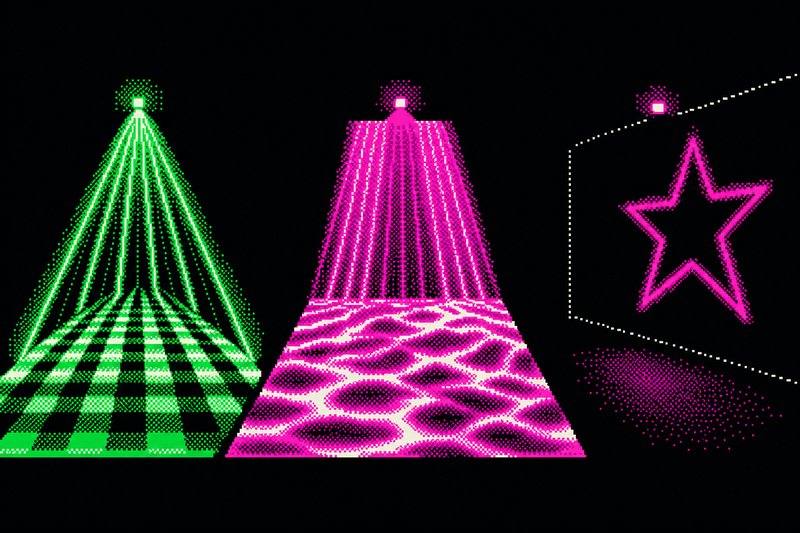
Every laser effect is a single point of light moving very fast. What the audience reads as a fan, a cone or a spinning logo is the scanner tracing a path many times per second, and the eye filling in the rest.
Show programmers split the effects into two families. Beam effects are meant to be seen in the air, so they live or die by haze. Graphics are meant to be seen where the light lands, on a wall, a screen, a building or a curtain of water, and they care about scan speed and the surface far more than about the atmosphere. Most shows mix both, and most projectors can do both, though not equally well.
Beam effects
Fans and sheets
A fan is the simplest beam look: the scanner sweeps the beam back and forth along one line, and in haze you see a flat, wedge-shaped plane of light opening from the projector. Slow the sweep and the plane breaks into separate beams that appear to walk; speed it up and it becomes a solid sheet. Many projectors add a diffraction grating, a small optic that splits one beam into a row or grid of beams, which multiplies a fan into several at once with no extra scanner work.
Tunnels and cones
Scan a circle and project it down the length of a hazy room, and the light forms a hollow cone that widens with distance. Point it at the audience from the stage and the crowd sees a tunnel; rotate the circle into an ellipse or wobble its size and the tunnel breathes. This is one of the oldest effects in the trade, and it still gets a reaction because it gives the room a shape.
Liquid sky
Liquid sky is a sheet of light scanned horizontally just above the audience's heads, then rippled with a slow wave so it looks like the surface of water seen from below. It needs a lot of haze, a projector mounted high and a fair amount of output power, because the sheet spreads its light over a wide area. It is also the effect most often subject to safety limits: the plane has to stay at a measured height above the tallest hands in the crowd, and in the US the venue's FDA variance sets where that line sits. The laser safety guide covers how those heights are worked out.
A digression that every lighting tech eventually learns: liquid sky looks better from the back of the room than from under it. Under the sheet you see the ripples; from the back you see the whole plane tilt and roll.
Aerial beams and mirror bounces
Outdoors and in large arenas, static or slowly moving beams are bounced off small mirrors placed around the venue, building a web of straight lines. The look is architectural rather than busy. It takes time to align on site, and every bounce point becomes another place where a beam must be kept away from eyes.
Graphics, text and logos
A laser graphic is a vector drawing. The software turns an outline into a list of points, and the scanners visit them in order, blanking the beam between separate strokes. Because the beam can only be in one place at a time, the number of points the scanner can visit per second limits how much drawing fits into one frame before it starts to flicker. That is why scanner speed, quoted in kpps at the ILDA test angle, matters so much more for graphics than for beams.
Simple text and line animations run comfortably on a mid-range projector. Detailed artwork does not. A dense corporate logo with fine lettering often has to be redrawn for the laser, with fewer points, rounder corners and thicker strokes, or split into parts that appear one after another.
That redrawing is the hidden cost of a logo reveal at a product launch or awards night. The client sends a vector file built for print, and a programmer spends hours simplifying it until it scans cleanly. Fills are the other limit: a laser draws outlines, so a solid block of color has to be suggested by hatching or left to a video projector working alongside. The cost guide explains how programming hours show up in a quote.
ToolScan speed
How scanner speed decides whether a graphic flickers
Move the slider to change the scanner speed and watch a simple outline drawn one point at a time. When the scanners cannot visit every point of the shape about 30 times a second, the drawing visibly redraws and flickers.
Mapping onto buildings and projecting onto water
Laser mapping onto a building is graphics at long range. The programmer traces the building's edges, windows and cornices from a photo or a plan, then animates lines that follow the architecture, so outlines appear to draw themselves around the facade. Lasers suit this because a thin beam stays sharp over hundreds of meters, which a video projector cannot match in brightness for the same weight of kit. The trade-off is the same as indoors: outlines, not pictures. Large mapping shows usually pair the lasers with video projection for color and texture.
Outdoor work brings airspace into it. In the United States, an outdoor laser show that sends light into navigable airspace must be notified to the FAA in advance, on top of the FDA variance, and some beam directions near airports are off limits.
Water screens are fine sprays or curtains of mist that act as a translucent projection surface. Graphics projected onto them seem to float in mid-air, and a beam passing through the mist glows along its whole length. The screen behaves differently from a wall: it scatters light forward, so the best view is from the side opposite the projector, and wind changes its shape constantly. Shows built around fountains, harbours and theme parks use them because they solve the problem of where to put a screen outdoors.
What each effect needs
| Effect | How it is made | Needs haze | Equipment priority |
|---|---|---|---|
| Fan or sheet | One-axis sweep, sometimes split by a grating | Yes | Output power, smooth scanners |
| Tunnel or cone | Circle scanned along the room | Yes | Even haze, projector aimed down the room |
| Liquid sky | Horizontal sheet rippled by a wave | Heavy | High mount, power, measured beam height |
| Aerial bounce | Static beams off placed mirrors | Yes | Mirrors, rigging time, alignment |
| Graphics and text | Vector outline drawn point by point | No | Scan speed (kpps), surface |
| Logo projection | Simplified vector artwork | No | Scan speed, programming hours |
| Building mapping | Outlines traced to architecture | No | Power, long throw, FAA notice outdoors |
| Water screen | Graphics or beams on a mist curtain | No | Water system, calm air, viewing angle |
Haze is the dividing line, and it is a practical one: some venues restrict haze because of smoke detectors, and without it the whole beam half of the table disappears. The fog and haze guide explains the options. For the projectors themselves, the equipment guide explains which spec on the data sheet drives which effect, and the moving head lasers page covers units that can re-aim a whole effect around the room mid-song.
A beam projector judged only by watts will disappoint on graphics. A graphics projector with fast scanners but modest power can look thin on a liquid sky in a big room, which is why mixed rigs exist and why a show designer asks about the room before naming a fixture.
Laser effect questions
What is a liquid sky laser effect?
A flat sheet of laser light scanned horizontally above the audience and rippled with a slow wave, so it looks like rolling water seen from below. It needs dense haze and a high mounting position.
Can a laser project a company logo?
Yes, as an outline. The artwork is converted to a vector path and usually simplified so the scanners can draw it without flicker. Solid fills and photographic detail need a video projector.
Why can't I see the laser beams?
Clean air does not scatter enough light. Without haze or fog you only see the spots where the beam lands, which suits graphics on a wall but hides every beam effect.
Do outdoor laser shows need permission?
In the US, a public show with Class IIIb or IV projectors needs an FDA variance, and an outdoor show that puts light into airspace must also be notified to the FAA beforehand. Local permits may apply on top.