Rack 04Yoke and mirrors
Moving Laser Lights Explained: How Moving Head Lasers and DMX Work
Published
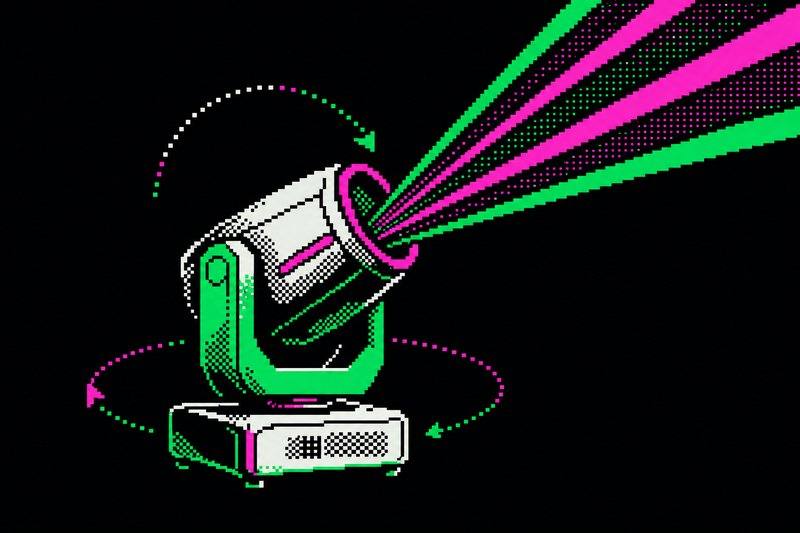
A moving head laser projector moves twice. Inside the head, two galvanometer mirrors draw the beam a few thousand times a second; outside, a motorised yoke swings the whole head around the room. The first motion makes the picture, the second decides where the picture goes.
That double layer is what separates a real moving head from the cheap moving laser lights sold for parties and garden hedges, which move a pattern but cannot aim it with any precision. It is also why these fixtures are heavier, rarer and more expensive than a static projector with the same output.
How a moving head laser works
Take a standard RGB laser projector, shrink it as far as it will go and mount it in a head between two arms. That is the basic layout of a moving head laser projector. The yoke carries a pan motor that turns the arms around the base and a tilt motor that rocks the head between them, the same arrangement used in moving head spot and wash fixtures. The laser engine sits in the head, with its diode modules, combining optics and scanners, so everything that makes light rides along with every move.
Explained in one line, two separate systems steer the beam. The galvo scanners work fast and over a narrow window, drawing fans, tunnels and graphics within perhaps forty or sixty degrees. The pan and tilt motors work slowly and over a huge range, pointing that window anywhere from the stage floor to the back wall. A cue can draw a fan with the galvos, then sweep it across the audience's heads with the yoke while the fan keeps spinning.
Power and data reach the head through slip rings or cables looped through the yoke, and a position sensor or homing routine lets the fixture find its zero point after power-up. If you hear a moving head buzz and twitch for a few seconds when the rig is switched on, that is the yoke finding its limits.
Why high-power units are rare, explained by weight and heat
Laser diodes turn a large share of their input into heat, and a projector of several watts needs heat sinks and fans to stay inside its operating temperature. In a static box that cooling can be as large as the housing allows. In a moving head every gram of it has to be swung around by the motors and held still at the end of a move, and the bigger the head, the stronger and slower the yoke has to be.
Heat explained only part of it. Alignment is the second problem. The dichroic mirrors that stack red, green and blue into one beam are set to fractions of a millimetre, and a head that is accelerated and braked hundreds of times a night puts them under far more strain than a projector bolted to a truss. Makers solve this with stiffer mounts and fewer adjustable parts, which adds weight again.
Safety is the third, and the one that limits how they are used. A static projector's beam window is fixed, so the safe zone can be measured once and set with masking in software. A moving head can point its window almost anywhere, including into the audience, which means the pan and tilt range has to be limited in the fixture or the controller and checked against the conditions of the operator's FDA variance. The laser safety guide covers what those conditions usually include.
Noise adds a smaller cost. Pan and tilt motors and the fans that cool the head are audible in a quiet theatre, which matters for a corporate keynote or a drama production more than in a club where the music covers everything. Fixtures built for those rooms often trade speed for quieter motors and slower fan curves, and spec sheets do not always say so; if the venue is quiet, listen to a unit running before ordering several.
The result is a product class that exists but stays small: most moving head models sit at the lower end of club power, and touring rigs that need real output still hang static projectors and accept that they point one way.
DMX channels on a moving head laser
Moving heads are almost always controlled over DMX512, and their channel maps follow the conventions of moving lights with a laser section bolted on. Each maker publishes its own map, often with a short mode and an extended mode, so the table below shows the typical groups rather than any one fixture.
| Group | What it controls | Notes |
|---|---|---|
| Mode or shutter | Laser on or off, DMX mode, sound or auto modes | Usually the first channel; a safe default keeps emission off |
| Pan and tilt | Yoke position | Often coarse and fine channels for 16-bit resolution |
| Pan/tilt speed | How fast the yoke moves | Slow moves look smoother and are easier on the head |
| Pattern | Built-in fans, lines, tunnels, graphics | Selected by value ranges within one channel |
| Size, position, rotation | Galvo-drawn pattern geometry | Zoom, X/Y offset and rotation of the pattern |
| Color | Fixed colors or RGB mixing | Mixing needs analogue modulation |
| Dynamic effects | Wave, drawing, strobe | Usually with a matching speed channel |
| Reset | Re-homes the yoke | Often needs a hold time to avoid accidental resets |
To a lighting console the fixture looks like any other moving head with a few unusual channels. Load the personality, patch it at an address and pan and tilt behave like they do on a spot fixture. The pattern channels are where the laser shows through, and they are where programmers spend their time.
Some higher-end units add an ILDA or network input, so laser software draws the content inside the head while the console drives the yoke. That split is the best of both, if the operator is willing to run two systems.
Programming the yoke is where a moving head earns or loses its place in the rig. Positions are stored as presets on the console, so a look such as a fan pointed at the mirror ball or a sheet low over the dance floor can be recalled in any cue. Because the beam is drawn by galvos and aimed by motors, a small error in the pan value moves the whole window, and a preset that was safe in one room can be wrong in the next. Most operators therefore re-check every position preset with the laser at low power after each rig, and keep the fixture's own pan and tilt limits set as a second barrier in case the console sends something unexpected.
Cheap moving laser lights and the projectors they imitate
Most products sold as moving laser lights are not moving heads at all. Holiday projectors that sprinkle green and red dots over a house use a diffraction grating and a slowly turning motor. Party units in the same price range swap the grating for a small stepper or galvo, which lets them move a pattern around in a fixed loop, sometimes in time with the music picked up by a built-in microphone. They are low-power, generally Class IIIa or 3R, and they are bought for the atmosphere rather than for control. Pointed upwards outdoors they are still not harmless: the FAA has warned that decorative lasers aimed at the sky can reach aircraft.
Static show projectors sit at the other end. They cannot move their window, but at the same price they usually offer more power, faster scanners and better beam quality than a moving head laser, which is why they carry most professional shows. The comparison of laser machines lists the four main types side by side, and the equipment guide explains how to read the spec sheets.
So when does a moving head make sense? When the beam window has to travel during a show: a corporate stage where the laser picks out a product on one side and then the speaker on the other, a club where a single unit sweeps the room in time with the moving lights, or a rental company that wants one fixture to cover many rooms without rerigging. In a fixed venue where the beams always go to the same place, a static projector is the better buy. For effects that depend on smooth motion, it helps to see the looks first in the guide to laser show effects, because many of them can be drawn by galvos alone.
Keep the moving laser lights from the garden center for the hedge.
Moving head laser questions
What is a moving head laser?
A laser projector mounted in a motorised yoke. Galvo scanners inside the head draw the pattern, and pan and tilt motors aim the whole head, so the beam window can be pointed anywhere in the room.
How many DMX channels does a moving head laser use?
It depends on the model and the mode. Many fixtures offer a short mode with the basic functions and an extended mode with fine pan and tilt and full pattern control; the maker's manual lists the exact map.
Are moving laser lights safe?
Low-power party and holiday units are designed for home use, but they should still never be aimed at eyes or into the sky. Professional moving heads are Class IIIb or IV and need limited pan and tilt ranges, an emergency stop and, in the US, an FDA variance for public shows.
Is a moving head laser projector better than a static one?
Only where the beam window needs to move. For the same price a static projector usually has more power and better beam quality, so most rigs use static units and add a moving head where motion matters.