Rack 08Making beams visible
Fog and Haze for Laser Shows: Machines, Fluids and Venue Rules
Published
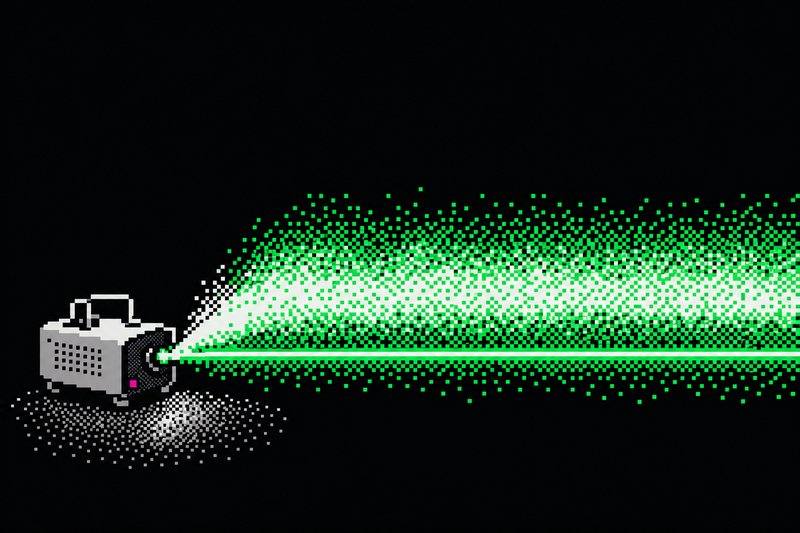
Switch on a twenty-watt projector in a clean, empty hall and you see almost nothing: a few bright dots on the far wall and a faint glow at the aperture. The beam is there the whole time. It only becomes a beam to the eye when something in the air scatters a little of its light sideways.
Why a laser beam needs particles in the air
Light travels in a straight line until it hits something. In clear air there is almost nothing for a narrow laser beam to hit between the projector and the wall, so almost no light reaches your eye from the path itself. Dust, smoke and fine droplets change that: each particle scatters a tiny amount of light in all directions, and millions of them along the path draw the line you see. Particles around the size of the light's wavelength scatter strongly forward, which is why beams look brightest when you stand behind or beside the projector and look along them.
Outdoors, humidity and dust sometimes do the job; indoors, a show brings its own atmosphere.
Fog, haze and low fog are different tools
A fog machine pumps fluid into a heated block, where it vaporises and condenses into a dense white cloud on leaving the nozzle. It works in bursts and makes the visible plumes people associate with concerts. For lasers it is a blunt instrument: a thick cloud lights up spectacularly where it is and leaves the rest of the room clear.
A hazer produces much finer particles and spreads them evenly, so the air looks almost clean while every beam in it becomes visible from end to end. Hazers are built to run for hours at a low setting, usually under DMX control from the lighting or laser desk.
Low fog hugs the floor. It is made by chilling fog through ice or a refrigeration unit, or by using dry ice, liquid CO2 or liquid nitrogen, and it stays down because it is colder and heavier than the air around it. For overhead beam fans it is useless, but a laser plane cut just above a carpet of low fog produces one of the classic stage looks, described in the effects guide.
| Type | How it is made | What you see | Laser use |
|---|---|---|---|
| Fog | Fluid vaporised in a heated block | Dense white clouds, short-lived | Bursts and accents |
| Haze | Fine mist from oil or water-based fluid | Thin, even, near-invisible atmosphere | Main medium for beam shows |
| Low fog | Chilled fog, dry ice, CO2 or nitrogen | Layer at floor level | Laser planes over the floor |
Water-based or oil-based haze
Water-based fluids are mixtures of distilled water with glycols or glycerin, the chemistry covered by the ESTA standard ANSI E1.5 for theatrical fog. Heater-type hazers use them, and they are the default in theatres and touring because the residue is light and most venues accept them. Oil-based hazers, such as the long-running MDG Atmosphere or the Reel EFX DF-50, atomise mineral oil, often without heat in the type called a cracker hazer. Oil haze is extremely fine, hangs in the air for a long time and gives a very even look on camera, which is why film and television crews like it.
The downside of oil is the film it can leave on surfaces, lenses and the floor over a long run, and some venues and unions restrict it.
Whatever the base, use the fluid the machine's maker specifies. A heater block tuned for one mix can spit or clog with another.
Hang time, airflow and coverage
Hang time is how long haze stays in the air before it settles, evaporates or gets pulled out. On a spec sheet it looks like a property of the fluid, but in a real room it is mostly a property of the ventilation. An air-handling system that swaps the room air every few minutes will strip haze faster than any hazer can make it, and outdoor wind does the same in seconds. Placing a hazer where the HVAC carries its output across the room, and adding a second unit in a deep hall, beats turning one machine up. That is also why a show that looked perfect at the afternoon rehearsal can look thin at night, when the doors are open, the room is full of warm bodies and the air conditioning is working harder to keep up with them.
Coverage claims on packaging are best read as a ceiling, not a promise.
How much haze a laser show needs
Less than most people expect. The aim is beams that read clearly from every seat while the audience barely notices the atmosphere itself. If people can see the haze as gray air, or the projected graphics on a screen go soft, there is too much. Operators usually start the hazer well before doors so the room fills evenly, then trim the output during the show rather than chasing it with bursts. Green beams need the least haze to look bright because the eye is most sensitive to green; deep blue and red need more for the same effect, which shapes how a show's colors are balanced.
Graphics projected onto a wall or screen need no haze at all. The trade-off between brightness, haze and projector power is one reason the cost of a laser show rises so quickly with room size.
Smoke detectors and venue rules
Optical smoke detectors and beam detectors work by sensing particles in the air, and haze is exactly that. A hazer running near a detector can set off the fire alarm and, in many buildings, call out the fire department. Venues handle this in different ways: some ban haze, some allow water-based fluid only, and some arrange for detectors in the show area to be isolated during the event with a fire watch posted, under a permit from the local fire authority. That decision goes through the venue's technical manager, well before the first rehearsal.
The same conversation usually covers the laser variance, which the laser safety guide explains.
Maintenance between shows
Most hazer failures come from fluid sitting in the machine. Run the unit dry or flush it with the maker's cleaning fluid before storage, keep fluid containers closed so they do not pick up dust and water, and never run a heater-type machine with an empty tank. Oil hazers need their nozzles and filters cleaned on a schedule, and a compressor that sounds different is worth checking before it fails mid-show. More on what sits inside a rig is in the equipment guide.
Transport cases for hazers need the tank empty: fluid in a tipped machine finds its way into the electronics.
Fog and haze questions
Can I use a fog machine instead of a hazer for lasers?
For short bursts, yes, but fog clouds are patchy and clear quickly. A hazer gives an even result with far less fluid.
Is stage haze safe to breathe?
Commercial fluids used as directed are standard in theatres and concert venues, and water-based glycol and glycerin fluids are covered by ANSI E1.5. People with asthma can be sensitive to haze, which is why some venues post a notice at the door. The fluid's safety data sheet is the document to check.
Will haze set off the fire alarm?
It can, especially with optical or beam smoke detectors. Clear the use of haze with the venue in advance; they decide whether detectors are isolated and a fire watch is needed.
Do laser graphics on a screen need haze?
No. Haze is only for seeing the beams in the air. Graphics, logos and text projected onto a surface are sharper without it.